Monday, July 18, 2016

Planning Assessments
---Yanhua Wang

Learning Objective: Students will demonstrate an understanding of the traditions, the products and perspectives of the cultures studied.
dafdd.jpg
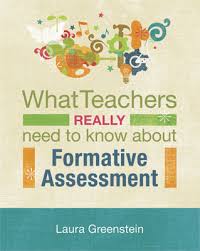
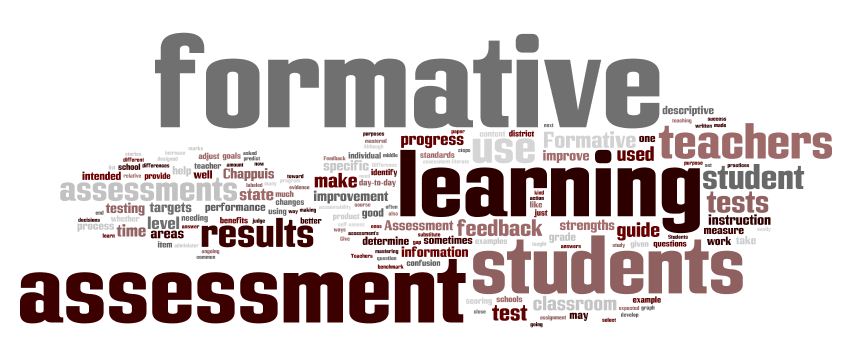
Formative assessment, including diagnostic testing, is a range of formal and informal assessment procedures conducted by teachers during the learning process in order to modify teaching and learning activities to improve student attainment.formative_wordle_2.jpg
Formative assessments using in this Chinese cultures learning class.
1. Characters and Pinyin Matching Game
The teacher prepared a Characters and Pinyin Matching exercise. Each student is handed out the paper in the class. The first three students who match the Characters and Pinyin correctly win the game.
This exercise can assess how many Characters and Pinyin the students can recognize and and how well they know the meaning of the Characters. The reason to design this part as a game is to activate students’ interest in joining class activities.
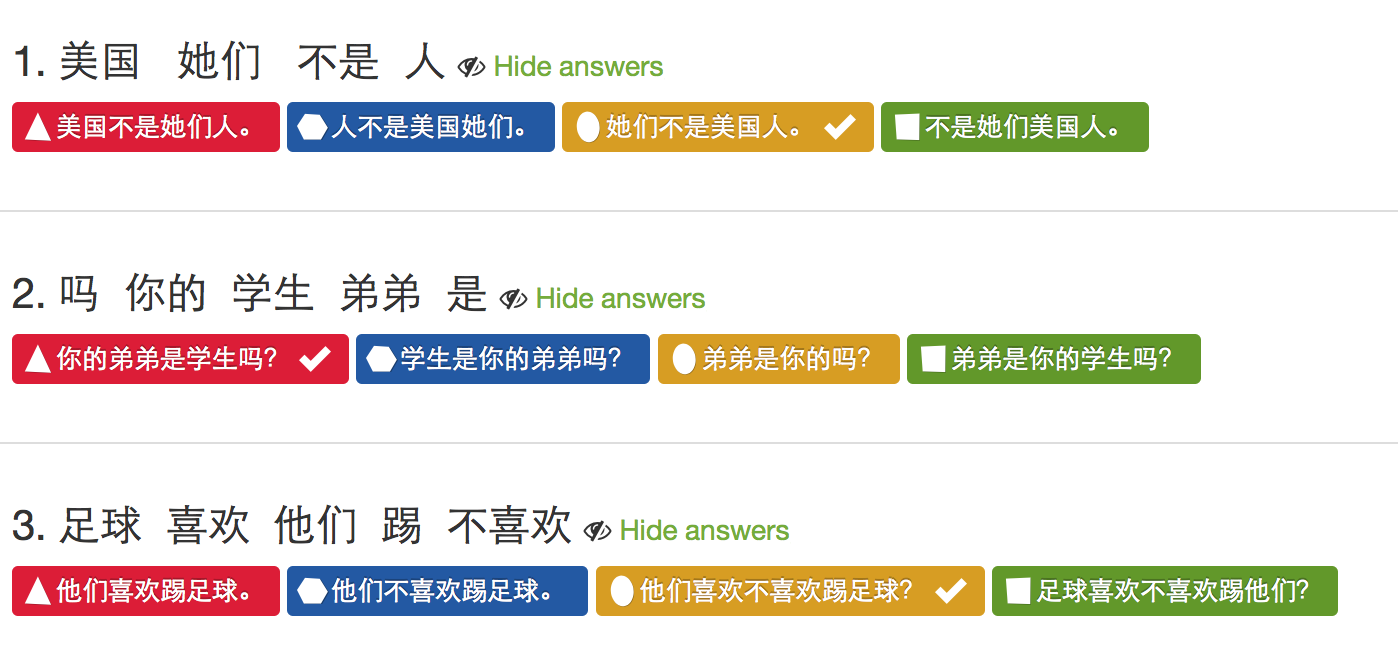
2.Interesting and funny little quiz--Playing Kahoot. Students use computers, cell phones, or other devices to join in the game. Student who gets the highest score is the winner.
Kahoot is a simple web tool to brighten and engage the classroom.The quiz generator walks me through a few simple steps to create a quiz.Most importantly, it gives me concrete data and feedback that I can actually use. This game is most suitable for middle or high school students.
3. Oral Presentation. After learning the words and expressions about the Chinese New Year, Students are divided into several groups and asked to make dialogues about what to say when people meet during the Chinese New Year. They have to use all the new words and expressions in the presentation.
It's tough enough for students to present something orally in their own language. They even feel twice as nervous in foreign language classes. Students of foreign languages get a double dose of jitters when they know they have to stand up before a class or even just in front of their teacher to make an oral presentation. But speaking is a very important part of learning language.Through the presentation, I can observe not only how they are doing in speaking, but also how well they have grasped the knowledge in this lesson. A rubric for oral presentation is used as criteria.

References:
1.Formative assessment. (n.d.). Retrieved July 18, 2016, from https://en.wikipedia.org/wiki/Formative_assessment
2.Formative Assessment. (n.d.). Retrieved July 18, 2016, from http://arincoaches.wikispaces.com/Formative Assessment


Sunday, July 10, 2016

Understanding and Applying Standards
---Yanhua
Many teachers help me and give me suggestions in my career, and all of them are helpful. I remember that after observing my lesson, a teacher suggested me to give students objective at the beginning of the class.
In the State I am teaching, there are core standards for world language, and the corresponding subject curriculum is made and issued.
The standards are the guide in directing me to fulfill the curriculum.  My teaching plans have to meet the standards, but I use the standards to help set up learning target and better improve students’ academic improvement.Since the standards are being implemented across the state I can benefit from the work that has already been done in this area.  Although the best understanding comes from doing, these resources will help me get started.
Unpacking a standard help me consider what students need to know and be able to do to demonstrate mastery of the standard.  It not only provides an opportunity for reflection by comparing and contrasting the expectations of a standard with my current curriculum; But also allows for the identification of professional development/ resources needed to implement each standard.
Backward mapping is a new concept for me to prepare lessons. I couldn’t believe it when I was told that backward mapping means the unit begins at the end.I was curious about the way it carries on.  And I find out that by beginning with the end in mind I am able to avoid the common pitfall of planning forward from activity to activity, only to find that some students are prepared for the final assessment while others are not.  Using backward design, teaching for understanding, and requiring students to apply and demonstrate their learning are not new concepts.  
Writing objectives: A learning objective is an explicit statement that clearly expresses what the student will be able to do after taking a course.It benefits students by helping them clarify their personal goals for a course and give them a framework against which to measure their own success.   
According to the-the core standard of world language in Connecticut, students can finally demonstrate an understanding of the tradition of the cultures studies. I design a New Year celebration class for students to better understand the Chinese cultures. I first write the objectives of the lessons. Assessment is also made to make sure that students really understand the essence of the cultures.


Standards and Backwards Mapping
---Yanhua Wang


I enjoy teaching every day. I like to see the smiles of my students when I help them solve the problems. I am now teaching Mandarin Chinese in a high school. Many of my students choose Mandarin Chinese as a second language because they are attracted by the Chinese cultures. And with more and more school districts offer Mandarin Chinese as one of the second languages, serial standards or guides have been made and issued. One of them is the Common Core of Learning-World Languages.The document is based upon the work of the National Standards in Foreign Language Education Project (1996) and recent research findings in world language education.It also provides a progressive development of essential concepts and skills for Grades pre-kindergarten - 12.
In this Unit, I am going to introduce 5 different topics to students, so that:        1.Students will understand and interpret spoken and written language on a variety of topics. (Interpretive)                         
2.Students will present information, concepts and ideas to listeners or readers on a variety of topics. (Presentational)                         
3.Students will demonstrate an understanding of the traditions, products and perspectives of the cultures studied.
In order to test how well do the students grasp the knowledge points of this unit, corresponding assessments are taken to  help me know students are meeting the standard.
1. Students will take a written quiz after finishing the unit. The quiz includes Pinyin, tones, Character writing and sentence writing.  After the quiz, I will analyze each part of the quiz. I will adjust the lesson plans to improve students academic performance.
2. Students are asked to make a book “story of me”. Students design, write and draw according to the requirement and the topics.
3. Students introduce the book to their classmates. They are going to introduce the book in Mandarin.
In the class, various teaching methods and activities are taking to attract students attention. Engaged students mean easier way to make sure students meet the standards. Activities in this unit include:
1. Stuff picking game: Students use chopsticks to pick up pasta and beans in given time. The one who pick the most wins the game and gets a prize. It’s a good time to introduce the history of using chopsticks in China.
2. Introduce what their partners are wearing today. When students are learning lesson “clothing”, they have to tell the rest of the class what their partners are wearing today. Students like to observe what other students are wearing, and with their introduction, students insensibly  review the-the expression of “clothing”.
3. Bring some balls with me to school. It’s a surprise to the students when they see the balls. But they only way they can play is to tell me the names of the balls and the expressions about sports.


Screen Shot 2016-07-09 at 4.58.27 PM.png          Screen Shot 2016-07-09 at 4.58.52 PM.png

Sunday, June 26, 2016

Applying Classroom Rules and Procedures
---Yanhua Wang
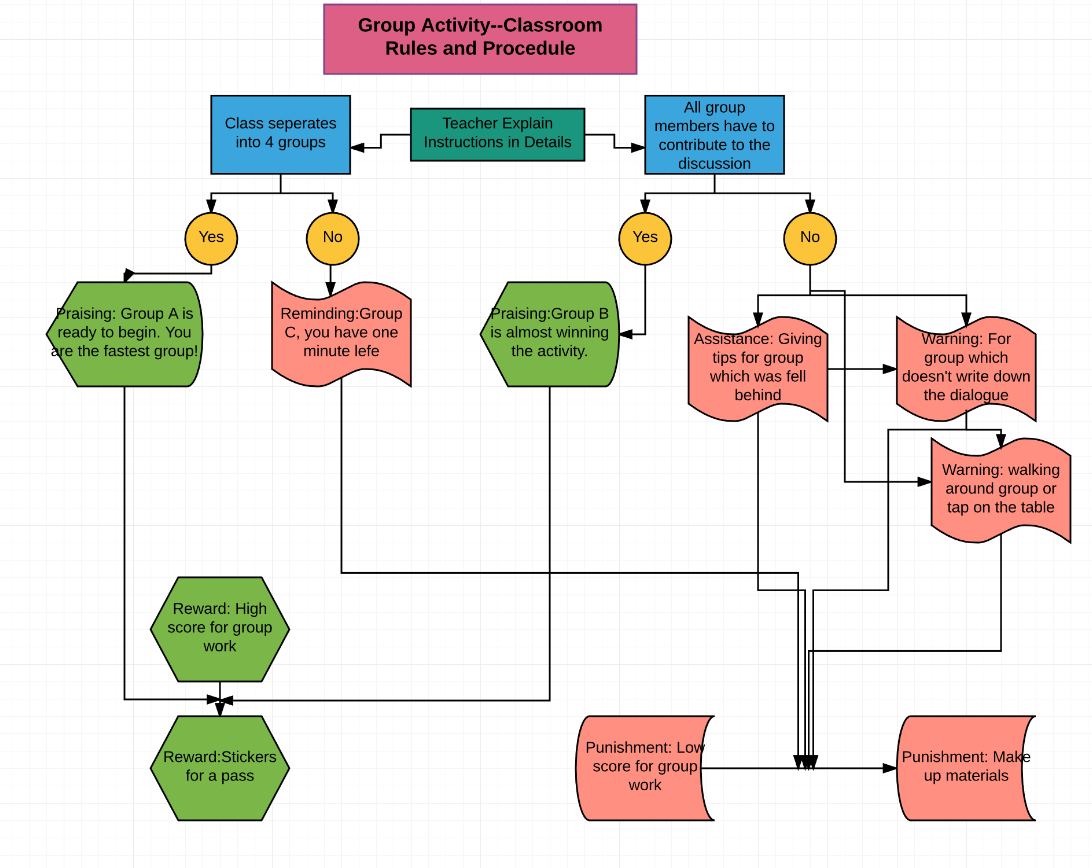
Teachers and students must create discipline plans including rules with clear and effective consequences. The rules should be agreed upon and understood by everyone in the class. It should be understood that when rules are broken, consequences will be applied fairly and consistently. In my classroom, I will explain in detail of classroom rules and the result. Action will be taken for punishment or rewards. Students will be given the opportunity to rectify  for the first one or two misbehavior. According to my experience, I will take actions towards two kinds of behavior.  I named the behavior as positive behavior and negative behavior.
I consider answering question actively, listening to other quietly,attending teamwork forwardly and helping other friendly as positive behavior; and sleeping during class, talking without a permit, not listening to instructions and keep bothering other students as negative behavior. I will have all the rules posted on the wall to make sure students have no excuse for breaking the rules. For students who are behaving excellently, I will liberally give them rewards. Leo Nikolayevich Tolstoy once said: Happy families are alike, the unhappy family is unhappy in its own way. I apply this famous saying in classroom management as “Excellent Performance is alike, bad performance appears in its own way.”
For well-behaved students I will have them bring home a reward card or a pass for a reasonable request like no homework for one time, not doing a project for one time. I have a student performance sheet hanging behind the classroom door. If a student is doing well in the class, I will put a sticker after his or her name.  For every sticker he or she collects, he or she can change them for a pass. It’s a very good example for other students because they also want to get the reward. James is a student in my class. He likes Chinese cultures very much, so he chose Mandarin Chinese as the second language. He is smart and hard working. I extremely like his attitude toward learning this subject. He not only attended class activities actively but also respected me and his classmates. He got many stickers in the last semester and he only used a pass for not doing homework for one time.
students are breaking the rules or not following procedures in many different ways. They may fall asleep, keep talking or not be willing to attend group activities. Chris had talent in learning languages. But as time passed I found out that he no longer actively answered questions as he used to do before. The worse was he didn’t hand in his homework on time. I talked with him alone, trying to figure out what happened to him. He told me that learning Chinese Characters was really hard for him. He felt like he was not able to catch up forever. I promised him that I could help him whenever he wanted. I used more teaching strategies to attract his attention. Chris was an introverted person. He liked to be encouraged, especially liked to be praised in public. I recognized that what he needed was an encouragement. So for every progress he made, I would tell him immediately with a big smile that he was doing a good job or he is the best. From then on he was doing better and better. After the final exam, he came to thank me for helping him build up his confidence.  

Classroom Behavior Process
Screen Shot 2016-06-26 at 10.33.32 AM.png

Monday, June 13, 2016

High-Performance Learning environments
---Yanhua Wang


Academic Expectations:
If I were asked to choose the best video, I would say the Roller Coaster Physics impressed me the most. No matter the video or the plan is very organized and methodic. The students listened to the instruction first, then worked in a group to discuss how to carry the project out. The individual sketch was the first step to making it possible. Finally, they were offered the materials to carry out the project. The teacher gave students time and space to finish the project. She was not staying away to do nothing but giving direction anytime the students needed. She also asked questions to further explain the theory of the project. Each group had finished the project. The students also tried to lower the budget, and they did it. The teacher surely holds high-performance expectations for students.
Video two is about 3rd-grade Chinese math. As a Chinese I am very confused by the scenario because in the video a Chinese teacher with Taiwan accent was teaching kids(foreigners?) Multiplication formulas. The kids were reciting the Multiplication formulas under the teacher’s guidance. Most of the kids raised their hands to answer the questions. Academic expectations can be achieved for most of the students. But some students may lose interest in this teacher-centered style education. So the teacher should use more teaching strategies to attract students’ long-term attentions in the class.
Whole brain teaching, a new teaching strategy is used by lots of teachers and the effect is quite obvious. But in this video, I feel like that I can’t even catch up with the steps. Most importantly, I don’t get the point of why doing this? What’s the objective of this lesson? I have too much doubt of the lesson so that I don’t think the teacher can hold high expectation for students.
Behavior expectations:
In the video Roller Coaster Physics, everything went on smoothly and naturally. It’s like every other lesson in every day. The students were required to work in the group, so no one had an excuse to stay away. They followed the instruction, finished every part of time.
The video 3rd Grade Chinese Math reminded me of my childhood when the math teacher taught us Multiplication formulas. The students listened earnestly. They did whatever the teacher said. Classroom management was much easier in this way.
The class in Whole Brain Teaching was tight and impassioned. Even though there were several instructions, the students still followed them properly.
Norms and Procedures:
The norms and rules of the class are clear. There was a restriction in using the equipment and materials. For example, each group could only have 2 marbles. The class was separated mainly in three parts: instruction, planning, and performance. The students listened, discussed sketched, computer outlined and performed step by step. The teacher seemed to understand the students well that the project is neither too hard nor too easy for the students. Besides, there was a budget limitation for the students. Once they spent too much the teacher would remind them of their budget.
In the 3rd Grade Chinese Math video, the teacher first reviewed Multiplication formulas and then did some exercise to enhance the knowledge for the students. I like the way that when they were going to next step, they counted the number rhythmically and clapped their hands.
When a teacher has to cheer students up, then Whole Brain Teaching would be a good way. As I said above, the rhythm of this whole brain teaching was going so fast that I couldn’t help thinking about if the students could remember something.
The three teaching strategies all have very good sides that I can learn from. I am teaching grade 9 students Mandarin Chinese. Students in my class came from Russia, Irish, India, Mexico and Paraguay. How to create a learning environment with high expectations for my students is always a priority when I prepare lesson plans. First, I will set up the rules in the class, but not too many instructions as that in the Whole Brain Teaching. Regarding the many cultural backgrounds in the class, I will ask students to talk about something interesting concerning their cultures. Two to three games will be used in the class, so I don’t have to spend much time in explaining the playing rules to students. I hope that one day my class can be as organized and high effective as  Donna Migdol’s  classroom.


Sunday, May 29, 2016

Positive Classroom Climate
---Yanhua Wang

Classroom Climate is the classroom environment, the social climate, the emotional and the physical aspects of the classroom. It’s the idea that teachers influence student growth and behavior. The student’s behavior affects peer interaction--the responsibility of influencing these behaviors is placed with the Instructor. The way the instructor organizes the classroom should lead to a positive environment rather than a destructive and/or an environment that is not conducive to learning.
------Dr. Karen L. Bierman, the Director of the Penn State Child Study Center and Professor of Psychology, believed that a teacher needs to be "invisible hand" in the classroom.

As we all know that the USA is the number one immigrant country in the world. There are students coming from South America, Asia, Europe and Africa in one class. They speak different languages, celebrate different festivals, have different food, influenced by different cultures. As the teacher in school, I think it’s really important to balance the relationship of students while still doing a good job in teaching the subject. Some teachers may be confused because they believe that teachers’ responsibilities are helping the students in the targeted subject, and there is nothing to do with students’ background. Well, let me tell you why it’s important for creating a climate of caring and concern in the classroom
First, respect is mutual. If you respect students’ cultures, they turn out to appreciate your respect and further respect you. Once you earn their respect, you earn their trust. Respect and trust each other is a very important first step to lead your class into easy management mode.
Second, avoid conflict. Conflict not only means fighting but sometimes it also means the smooth going of the class. Think about it that how does an Indian student feel if other students are talking about how tasted beef is. Or the teacher keeps talking about the family union, parenthood in front of single parent family.
Third, set up a harmony learning environment. I believe students’ learning efficiency would be higher is they are studying in a harmony learning environment. They will grasp the knowledge point very quickly;  they will finish homework on time; they will work together for the project.
In my class, I always pay special attention to understanding students’ background. Here are several steps I take to ensure I have a positive classroom climate.
I introduce myself to the students at the very first beginning of the semester. I want my students to know who I am and what kind of person I am. I also tell them in detail about what they are going to learn in the semester. I ask their opinions or expectation about the subject so they know that I care about their thoughts. I ask them to introduce themselves, their ages, hobbies, families, cultures, ethics, idols. I tell them that we have to know each other well so we can get along with each other.
I schedule a quiz for the students. I have to know how were they doing about the subject in the past year. I analyze the quiz and adjust my lesson plan toward different students. I want to make sure that they will make progress in my class.
I celebrate with my students their festivals, their cultures. I not only teach them Chinese cultures but also do research about my students’ cultural background. My students will introduce their culture to other students whenever there is a chance. For example, on St Patrick's Day, Irish student makes a presentation in the class to share how their family and relative celebrate this festival; the history and tradition of St Patrick’s day. I make sure that my students are proud of their cultures.
I consider communication as a very important part of positive classroom climate. I prepare rubrics for projects, tests to avoid any misunderstanding of the subject. If there is any abnormal behavior of the students, I will always talk with them face-to-face. I prefer to solve problems as soon as possible. I will find out the background story first before taking any action.
There are a lot to do to build up a positive classroom climate. Not only the teacher has to work hard to make sure everything going on well, but also the students have to contribute their effort.


Reference:
1.Bierman, Karen L. (September–October 2011). "The promise and potential of studying the "invisible hand" of teacher influence on peer relations and student outcomes: A commentary". Journal of Applied Developmental Psychology. SI Teachers and Classroom Social Dynamics 32 (5): 297. doi:10.1016/j.appdev.2011.04.004. Retrieved 23 October 2013.
2."Classroom Climate". Center for Innovative Teaching and Learning. The Trustees of Indiana University. Retrieved 23 October 2013.

Sunday, May 22, 2016

Making Learning Fun
---Yanhua Wang


I am teaching Mandarin Chinese as a second language for  students  who  have never  known Mandarin Chinese before. Language includes listening, reading, writing and speaking. To acquire a language, students need many opportunities to practice and apply what they have learned in class. The  Mandarin Chinese language classroom often poses challenges in this area due to rote teaching methods, dull curricula, or limited opportunities to use the language outside of the classroom. Practicing a new language can also be intimidating, especially for students with a high affective filter or negative emotional factors that may interfere with language learning.
A great way to give students meaningful opportunities to apply their learning and lower their affective filter is to make learning fun! When teachers use activities that make learning engaging and fun, students are more willing to participate and take risks. Having fun while learning also helps students retain information better because the process is enjoyable and memorable. Besides with the development of modern technologies, it’s already a tendency for students to acquire computer skills.
Mobile learning is one of the ways I use to make learning fun and effective. As far as using mobile learning also has its disadvantages, which includes distraction of attention, wi-fi issues, charging factor and so on, I have to think about how to carry forward the advantages and reduce the disadvantages. Some guiding principles turn out to be very necessary.
1.Does every student have computers? Any charge and internet access in the classroom?
2.Are they familiar with the apps? If not, how long would it take to train them?
3.What’s the students’ prior knowledge of this digital content?
4. Is there specific preparation that needs to be done before the lesson?
5.By using this mobile device, does it aid the students in reaching the learning goal?
6.Does it cause more distractions than it’s worth?  
7.Could a different technology or teaching technique be used to reach the goals more effectively?
8.Do I have backup plans if something happens and the mobile learning doesn’t work?
9.How do I monitor what are the students doing?
10.How am I sure that mobile learning should only enhance student-centered learning and the reinforcement of the targeted learning outcomes?
When my answers to those questions are 95% positive, I then will use mobile learning strategy in my class. Here are the two apps I often use in the class.
The first app I use is for the students to learn Chinese Characters. As far as we don’t have environment here for students to read, to listen and to speak in Mandarin Chinese, I have to figure out a learning environment for the students.  In this case,  It’s extremely important that there is an app with Chinese Pinyin. While this app really helps me a lot in typing Pinyin. The app has flashcards and it’s very flexible to use because it has a lot of choices. I can either use Characters, Pinyin or both of them, besides I can choose to turn the audio on or off. so whenever I want to review the Characters, I will use the flashcards.                       
Screen Shot 2016-05-20 at 1.34.03 PM.png

Another app I use is a game. Just a couple of decades ago, it’s unimaginable that human beings can use mobile learning in class.This app is a platform where one can create quizzes, discussions and surveys. It can also display via a TV or projector, and participants enter the game pin to play. I use it as a formative assessment.  At the same time I am able to collect valuable data about where the students’ abilities are. One of the best features of the app is that it collates the data for me in a downloadable spreadsheet, where I can see if students are struggling in their weakpoints.

Generally, I think mobile learning is very useful tools to make class fun. Students are also making progress step by step. I believe that if we can make best use of the advantages and bypass the disadvantages of mobile learning, we can have more choices of teaching and learning.


Reference:

1.Teacher's Corner: Making Learning Fun. (n.d.). Retrieved May 18, 2016, from https://americanenglish.state.gov/resources/teachers-corner-making-learning-fun