Friday, September 21, 2018

Whole Language Learning Theory


I am teaching  9th to 12th students Mandarin Chinese in a magnet high school.
Before I read Whole Language: Integrating the Language Arts--and Much More, I didn't know the concept of "whole language". I read articles recommended by my instructor and by google research. I agreed with What’s Whole in Whole Language. “Learning language became hard by breaking whole (natural) language up into bite-size”.
I started to learn English when I was in middle school. English is a mandatory subject even today in China. But back in the 1990s, there was seldom any English supplemental materials in urban China that teachers or students could use, not to say online resources. My teachers learned English from their teachers, who all have never had any chance to communicate with a person from English speaking countries. We started with phonogram, words, phrases, sentences and then reading comprehension. Our teachers sometimes played tapes of the textbook to us. Thirty years later, my first-grade son came home with sight words assignment. I then knew what “sight words” means after googling. I still felt ashamed of my accent. I spoke less to avoid being teased. I am still nervous when people asked me to repeat what I said. I read novels, even though not too many, to expand vocabulary. I watched videos like “improve your accent”. I attended the master program to practice writing and reading. Now as a Mandarin Chinese teacher, my experience as an English learner and a second language teacher would definitely help my students avoid detour in learning a second language.
What I am implementing now in my class include:
1. a Chinese style classroom.
I decorated my classroom with lanterns, ornaments, pictures, and a sight words wall.
2. I bought books from China and labeled them from easy reader to intermedium levels.
3. I collected videos from youtube or other websites and shared the link in Edmodo, so my students could practice listening anytime, anywhere.
4. I designed my lesson according to topics. ex. I encouraged students to order food from a Chinese restaurant when they have learned “ordering food”. I inspired by their excitement when they used what they have learned in class to real life.


Reference
Goodman, Ken. What’s Whole in Whole Language. Berkeley CA: RDR Books, 2005. pp.3-7.
Goodman, Ken. What's Whole in Whole Language? A Parent/Teacher Guide to Children's Learning. Portsmouth, NH: Heinemann Educational Books, 1986. [ED 300 777]

Monday, September 5, 2016


Teacher Evaluation
                 ---Yanhua Wang


"...teacher evaluations must be about improving teaching, not just rating teachers." —AFT president Randi Weingarten


The success of any evaluation system—no matter how solid its design—ultimately depends on how well it is implemented.
Schools, like companies, should have an evaluation system to evaluation teacher performance. As a teacher, I don’t mind to be evaluated because I believe it will motivate teachers to better do their job.School leaders should evaluate every teacher once a year.  I think that teacher evaluations are of utmost importance to the quality of education.It’s a way to provide teachers with some feedback on the success of their teaching in light of their “lesson plans.”Evaluation concerns itself with more than how well a teacher teaches. It is also about how a teacher works with the classes of students that make up a teacher’s teaching assignments. Proponents of evaluation systems that include high-quality classroom observations point to their potential value for improving instruction. An effective teacher evaluation system supports high-quality teaching and improved student learning in many ways.
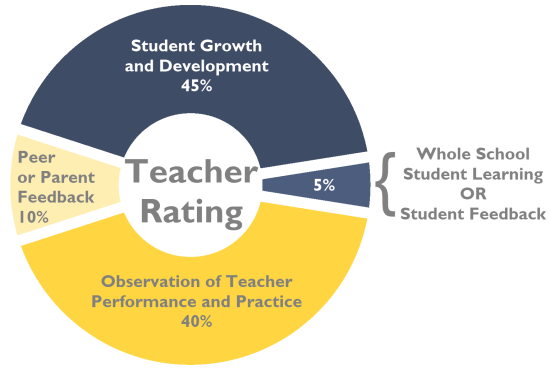
In the school district I teach, teacher observations, student learning outcomes, and feedback from parents compose the teacher evaluation system. It’s a fair, accurate, and comprehensive picture of a teacher’s performance. Here is the combination of teacher evaluation:                        
Teacher Performance and Practice(40%)
Parent Feedback(10%)
Student Growth and Development(45%)                    
Whole-School Student Learning Indicator and/or Student Feedback (5%)  
EvalutionPercentage.png

The role of teacher is often formal and ongoing. Teacher performance and practice with student growth and development account for 85% of teacher evaluation, which I think is very reasonable. As a teacher, I care about what my students learn from me. I want to set up a good example for my students. The ways I can achieve these are doing the best of myself as a teacher, preparing my lessons well and making the most out of it. I also like to listen to feedback from parents and students. Because I always want to make improvement every day.
As the person being evaluated, I think it’s very important to hear my voice of the evaluation system. It’s really necessary to ask teachers’ opinions when making the system. Somehow, teachers are working on the front line of education, we deserve the right to know how we are going to evaluate.

Friday, August 19, 2016

Pre-assessment and corresponding strategies
---Yanhua Wang

When a teacher is going to prepare lesson plans, a very important thing to know is students’ levels. In this case, pre-assessment seems very necessary and useful. Pre-assessment is a test students can take before a new unit to find out what the students need more instruction on and what they may already know. Pre-assessment is a way to save teachers time within the classroom while teaching new material. Experienced teachers know that if a student lefts behind and no measure is taking by both himself/herself and the teacher, he/her will finally loses interest and confidence in the subject. And at that time it will be extremely hard to pull him/her up again.
When I begin a new unit, I usually would like to not only review the previous unit, but also ask my students to do some pre-homework about the topic they are going to learn. On one hand, they won’t forget the knowledge they have learned, on the other hand, they will have a general idea of what they are going to learn. A quiz or game levels from easy, medium to hard and analyzes automatically helps me easily know my students’ levels. For pre-assessment, I recommend quizlet or kahoot.
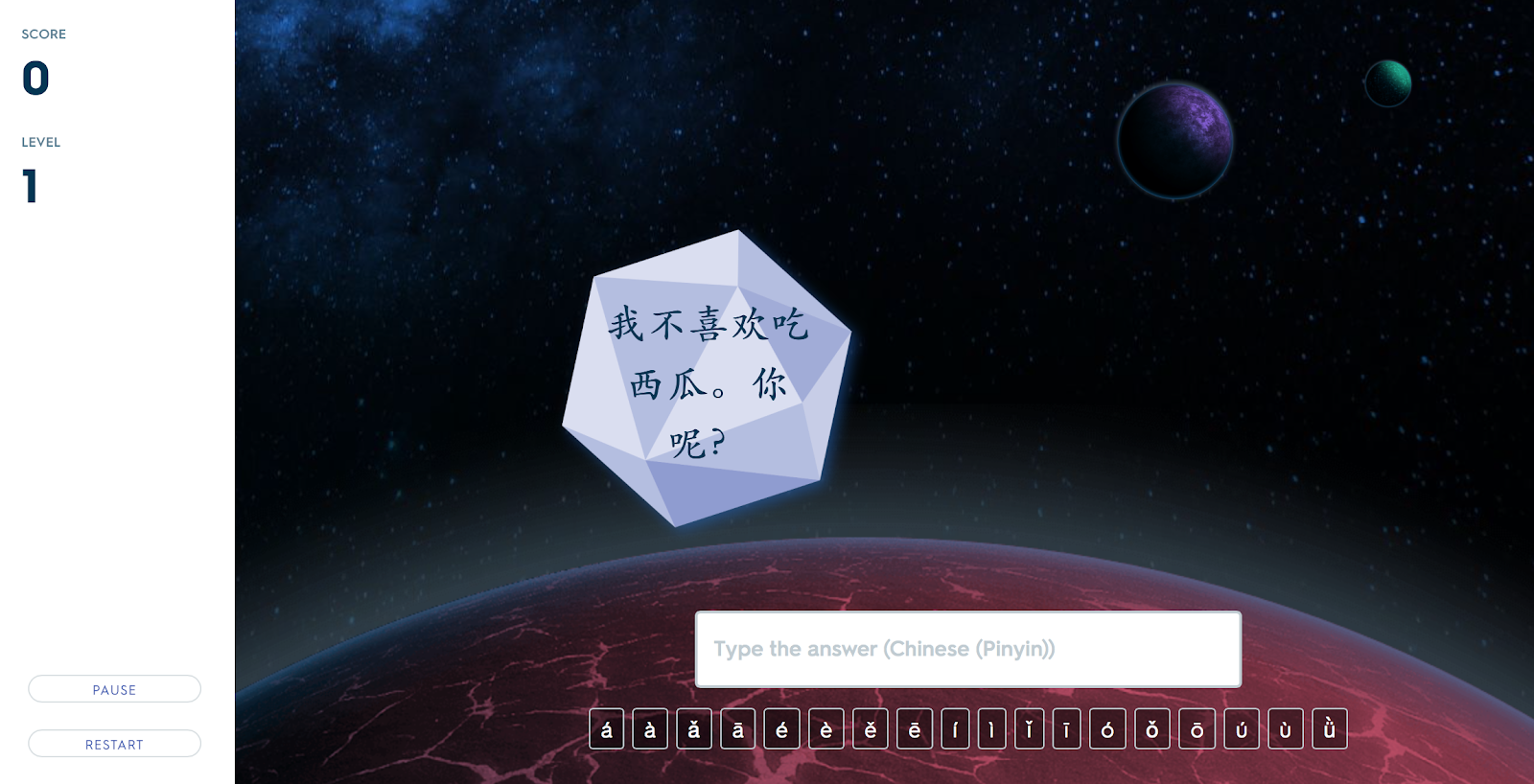
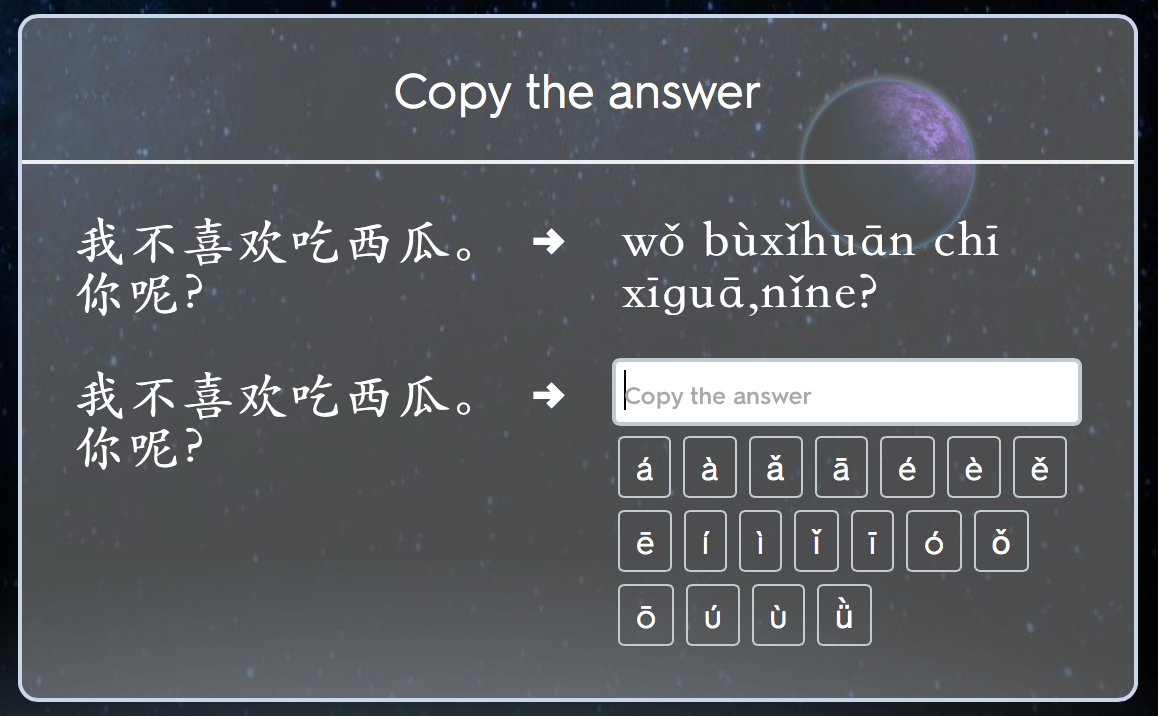
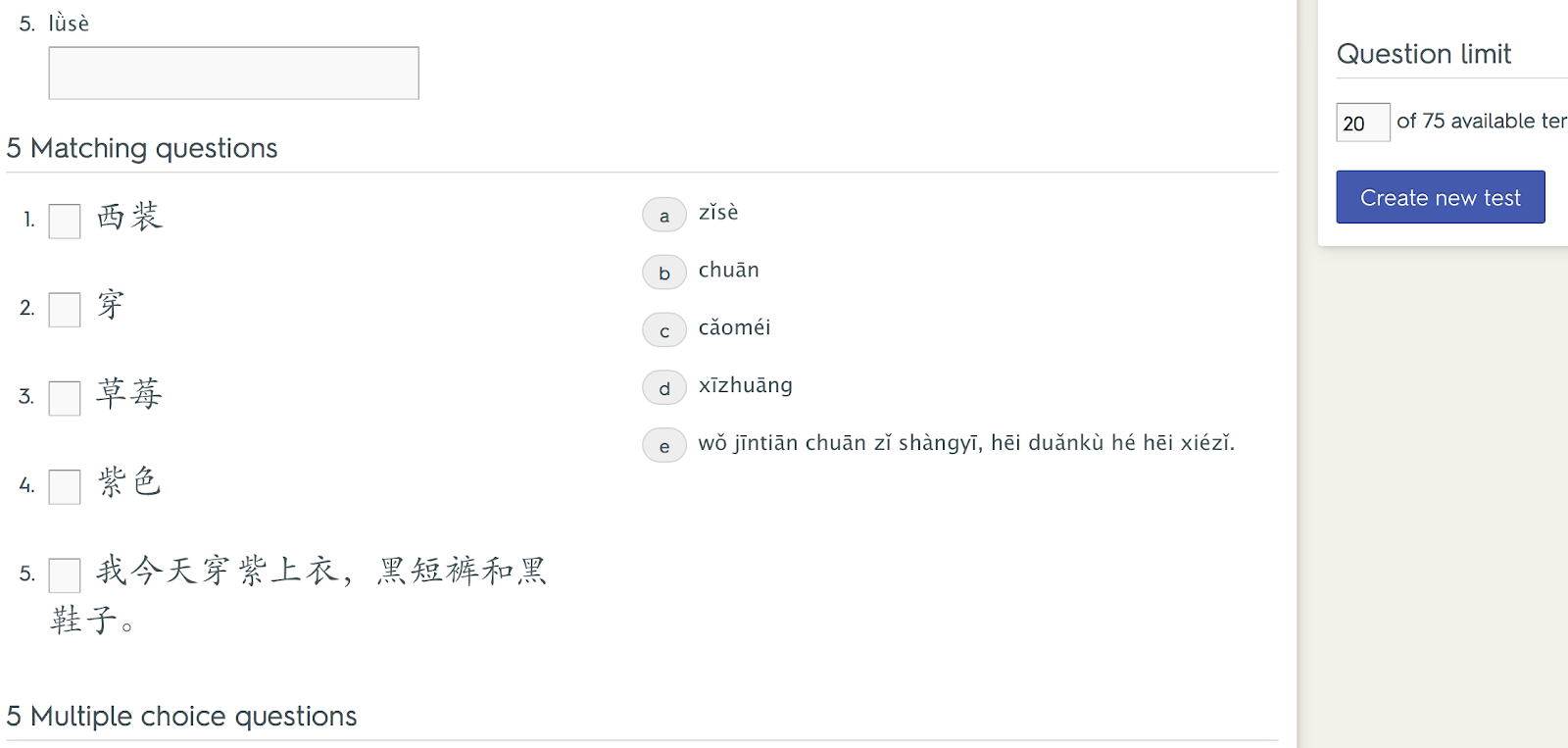
In the unit “fruit & color”, I make a game and a quiz in quizlet. There are combined questions, which includes: “phonetics”, “words”, “expressions” and “sentences”. Students who answer the questions fast and correctly win.
        
The game:
Screen Shot 2016-08-19 at 2.03.06 PM.png Screen Shot 2016-08-19 at 3.35.30 PM.png


Screen Shot 2016-08-19 at 3.35.56 PM.png Screen Shot 2016-08-19 at 3.36.25 PM.png


The test:
Screen Shot 2016-08-19 at 3.47.17 PM.png

Screen Shot 2016-08-19 at 3.47.32 PM.png


After the pre-assessment, students are arranged to three different groups:
  • the 5 students who answered most, including the most difficult, of the pre-assessment questions correctly
  • the 12 students who have some knowledge about the topic as shown in their score, but need to develop higher order thinking skills
  • the 5 students who appear to have limited knowledge about the topic
According to their performance, different strategies are taken to help them in new unit learning. Innovative Differentiation Strategies
  
Screen Shot 2016-08-19 at 3.53.01 PM.png

With pre-assessment pre-lesson and various strategies used during the lesson learning. Students not only learn in an interesting and happy environment, but also improve their academic performance dramatically.

Monday, August 15, 2016

High Stakes Assessment---Opinions differ from each other
---Yanhua Wang

I grow up in a country  where tests used to be the only way to judge a student’s academic performance. I took so many tests that I felt myself grow numb in taking tests. I was like many students that had no idea if tests motivated us to study harder or it’s the only way schools and parents pushing us forward.
I know that students in the US have to take SAT to apply for colleges. The score of SAT may not be the only reference that colleges enroll their students, but we all know that it’s an important element. A long time ago, I took my college entrance exam and it’s the only way for me and for 99% of the high school students to colleges.
The National Higher Education Entrance Examination  commonly known as Gaokao  is an academic examination held annually in China. This examination is a prerequisite for entrance into almost all higher education institutions at the undergraduate level. It is usually taken by students in their last year of senior high school, although there has been no age restriction since 2001. From the first day on in high school, everyone knows that the only target is to get higher scores as possible in Gaokao. some 9.4 million students took the test this year, competing to get into the country's top universities amidst incredible pressure from their parents and families. Students studied non-stop for a year, sat in class from 7:00 a.m. to 9:00 p.m., plowed through "tons of homework." Then it all came down to one big series of tests for 9.4 million stressed-out Chinese students.Some people describe it as the “competitive exam” in the world.

                                           Gaokao-students.jpg
                                                                                                                                                                                                                                                                                                                                 
I have friends whose daughters had or are going to take SAT for college entrance in the US. But I still can tell the differences between Gaokao and SAT. They are hard working, too. But they don’t have much pressure as Chinese high school students. I then find out why. Unlike the Gaokao, the SAT is offered multiple times per year. This means that if you don't do as well as you might like on the first time you take the SAT, you can always just schedule yourself to take the test again on another testing date farther down the road. So in the end, you should be viewing the SAT as an additional opportunity for yourself, and not as another test to stress over and worry about.
Let’s come back to the Gaokao, even with lots of criticism saying that college enrollment should consider other aspects instead of the exam results, people still believe Gaokao exam is the fairest to change one’s destiny, especially those who come from the remote area. Because many kids from poorer families have the gaokao as the only path to change their destiny.After years of reform and educational progress, the odds of success for grassroots students are much higher. Though the gaokao is a very narrow path, rural children embrace it as the best chance to enjoy a better life in future. Though many believe the exam-centered mindset does no good to youngsters' creativity, any radical change will spawn a public backlash as the gaokao is still widely regarded as the fairest means of selection. At least 70% of the young people experienced Gaokao, and they all know how uneasy lives were in high school. But survey indicated that 85% of the people agree to keep Gaokao.  The system has been tested and improved over the past decades, so it is better to stick to it if a multi-evaluation cannot guarantee a strict and transparent process with supervision, otherwise many disadvantaged people may lose their chance to get enrolled.
Time flies, my kid now goes to elementary school. He seems to enjoy school life. Up till now, I received an email from school about a math test-- IREADY SCORE.  It’s a mathematics assessment  allows teachers and parents to better understand students’  performance compared to national peers at the same grade level and students’  grade level performance based on school district  curriculum. For example, a student in grade 3 who has a percentile rank of 85 on the fall assessment performed in the top 15 percent nationally while also scoring in the“Meeting” level at that time in grade 3. Another test--STAR Reading Assessment is for grade 3-8. Through the test, I can better know how is my kid doing in math. I believe that school, teachers, parents and students have no pressure for the scores. Happily learning and making progress is my expectation to my kids. I hope that students far in China can enjoy the process of learning instead of torturing by test to test.


References:

1.National Higher Education Entrance Examination. (n.d.). Retrieved August 15, 2016, from https://en.wikipedia.org/wiki/National_Higher_Education_Entrance_Examination
2.Xinhua Insight: Gaokao exam still fairest to change destiny. (n.d.). Retrieved August 15, 2016, from http://news.xinhuanet.com/english/2016-06/08/c_135423243.htm

3.Differences Between the Gao Kao and the SAT in China. (n.d.). Retrieved August 15, 2016, from https://www.petersons.com/college-search/sat-china-chinese-international-students.aspx

Monday, July 18, 2016

Planning Assessments
---Yanhua Wang

Learning Objective: Students will demonstrate an understanding of the traditions, the products and perspectives of the cultures studied.
dafdd.jpg
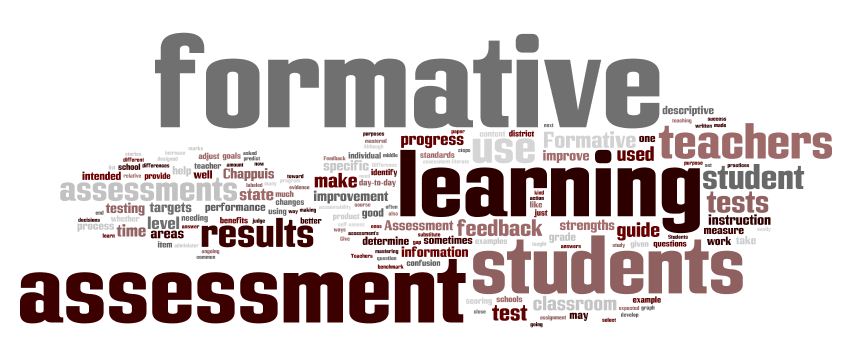
Formative assessment, including diagnostic testing, is a range of formal and informal assessment procedures conducted by teachers during the learning process in order to modify teaching and learning activities to improve student attainment.formative_wordle_2.jpg
Formative assessments using in this Chinese cultures learning class.
1. Characters and Pinyin Matching Game
The teacher prepared a Characters and Pinyin Matching exercise. Each student is handed out the paper in the class. The first three students who match the Characters and Pinyin correctly win the game.
This exercise can assess how many Characters and Pinyin the students can recognize and and how well they know the meaning of the Characters. The reason to design this part as a game is to activate students’ interest in joining class activities.
2.Interesting and funny little quiz--Playing Kahoot. Students use computers, cell phones, or other devices to join in the game. Student who gets the highest score is the winner.
Kahoot is a simple web tool to brighten and engage the classroom.The quiz generator walks me through a few simple steps to create a quiz.Most importantly, it gives me concrete data and feedback that I can actually use. This game is most suitable for middle or high school students.
3. Oral Presentation. After learning the words and expressions about the Chinese New Year, Students are divided into several groups and asked to make dialogues about what to say when people meet during the Chinese New Year. They have to use all the new words and expressions in the presentation.
It's tough enough for students to present something orally in their own language. They even feel twice as nervous in foreign language classes. Students of foreign languages get a double dose of jitters when they know they have to stand up before a class or even just in front of their teacher to make an oral presentation. But speaking is a very important part of learning language.Through the presentation, I can observe not only how they are doing in speaking, but also how well they have grasped the knowledge in this lesson. A rubric for oral presentation is used as criteria.

References:
1.Formative assessment. (n.d.). Retrieved July 18, 2016, from https://en.wikipedia.org/wiki/Formative_assessment
2.Formative Assessment. (n.d.). Retrieved July 18, 2016, from http://arincoaches.wikispaces.com/Formative Assessment


Sunday, July 10, 2016

Understanding and Applying Standards
---Yanhua
Many teachers help me and give me suggestions in my career, and all of them are helpful. I remember that after observing my lesson, a teacher suggested me to give students objective at the beginning of the class.
In the State I am teaching, there are core standards for world language, and the corresponding subject curriculum is made and issued.
The standards are the guide in directing me to fulfill the curriculum.  My teaching plans have to meet the standards, but I use the standards to help set up learning target and better improve students’ academic improvement.Since the standards are being implemented across the state I can benefit from the work that has already been done in this area.  Although the best understanding comes from doing, these resources will help me get started.
Unpacking a standard help me consider what students need to know and be able to do to demonstrate mastery of the standard.  It not only provides an opportunity for reflection by comparing and contrasting the expectations of a standard with my current curriculum; But also allows for the identification of professional development/ resources needed to implement each standard.
Backward mapping is a new concept for me to prepare lessons. I couldn’t believe it when I was told that backward mapping means the unit begins at the end.I was curious about the way it carries on.  And I find out that by beginning with the end in mind I am able to avoid the common pitfall of planning forward from activity to activity, only to find that some students are prepared for the final assessment while others are not.  Using backward design, teaching for understanding, and requiring students to apply and demonstrate their learning are not new concepts.  
Writing objectives: A learning objective is an explicit statement that clearly expresses what the student will be able to do after taking a course.It benefits students by helping them clarify their personal goals for a course and give them a framework against which to measure their own success.   
According to the-the core standard of world language in Connecticut, students can finally demonstrate an understanding of the tradition of the cultures studies. I design a New Year celebration class for students to better understand the Chinese cultures. I first write the objectives of the lessons. Assessment is also made to make sure that students really understand the essence of the cultures.


Standards and Backwards Mapping
---Yanhua Wang


I enjoy teaching every day. I like to see the smiles of my students when I help them solve the problems. I am now teaching Mandarin Chinese in a high school. Many of my students choose Mandarin Chinese as a second language because they are attracted by the Chinese cultures. And with more and more school districts offer Mandarin Chinese as one of the second languages, serial standards or guides have been made and issued. One of them is the Common Core of Learning-World Languages.The document is based upon the work of the National Standards in Foreign Language Education Project (1996) and recent research findings in world language education.It also provides a progressive development of essential concepts and skills for Grades pre-kindergarten - 12.
In this Unit, I am going to introduce 5 different topics to students, so that:        1.Students will understand and interpret spoken and written language on a variety of topics. (Interpretive)                         
2.Students will present information, concepts and ideas to listeners or readers on a variety of topics. (Presentational)                         
3.Students will demonstrate an understanding of the traditions, products and perspectives of the cultures studied.
In order to test how well do the students grasp the knowledge points of this unit, corresponding assessments are taken to  help me know students are meeting the standard.
1. Students will take a written quiz after finishing the unit. The quiz includes Pinyin, tones, Character writing and sentence writing.  After the quiz, I will analyze each part of the quiz. I will adjust the lesson plans to improve students academic performance.
2. Students are asked to make a book “story of me”. Students design, write and draw according to the requirement and the topics.
3. Students introduce the book to their classmates. They are going to introduce the book in Mandarin.
In the class, various teaching methods and activities are taking to attract students attention. Engaged students mean easier way to make sure students meet the standards. Activities in this unit include:
1. Stuff picking game: Students use chopsticks to pick up pasta and beans in given time. The one who pick the most wins the game and gets a prize. It’s a good time to introduce the history of using chopsticks in China.
2. Introduce what their partners are wearing today. When students are learning lesson “clothing”, they have to tell the rest of the class what their partners are wearing today. Students like to observe what other students are wearing, and with their introduction, students insensibly  review the-the expression of “clothing”.
3. Bring some balls with me to school. It’s a surprise to the students when they see the balls. But they only way they can play is to tell me the names of the balls and the expressions about sports.


Screen Shot 2016-07-09 at 4.58.27 PM.png          Screen Shot 2016-07-09 at 4.58.52 PM.png